Maybe sometimes it’s better not to know

I now know what I didn’t know last Saturday before noon. I know so much more, and yet I know I probably know only a small window, but that small window is plenty to hurt the heart. I came to this dissociation journey with parts first, and just hazy memories that really didn’t compute for me how they led to the parts I have. When the question would come up if I am a survivor, I would say, “I guess?” in that not so sure, questiony, wishy washy answer that would annoy me because it’s not like me to be wishy washy with answers.

And the memories keep coming like a flood, a freight train. So much crying and so much pretending. Pretending because I have to work. Thank god for remote work. Thank god for parts. I’ll cry, and then my part that loves to work will emerge like magic for a meeting. Then, when it’s done, we’ll cry for a spell. I’m thankful that I’m not called upon all too often for a sudden or unplanned need for an on-camera meeting. Usually, if something comes up, I just get a Teams message. I can read a Team message through tears. Sure, I welcome work distractions while my brain is flooded with images. For a spot of time, I can pretend I don’t have images in my head, and I can work on something someone needs from me.

On a good day, my work part will completely take over, and I’ll feel like I can do anything because this part is, quite frankly, awesomely confident and unflappable. I have a new therapist, and he called me this week on one of those good days. He caught on right away that a different part was talking to him on the phone. He said, “Hmmm, who am I speaking with?” The next day he said to me, “She’s so articulate!” I said, “Yes, I wish she was here all the time.”

I’ll get a respite from the memories, and I’ll mistakenly think it’s over. And I’ll feel almost like myself again. But, it’s a trick. They come back. I asked my wife, “Do you think it’s over? That’s it?” She just looked at me with so much love, and I don’t remember what she said, but I know it was an answer I didn’t want to hear. And, yes, later that same day the memories were back, like they never left.

I thought, wrongly, that I knew all there was to know about that place and time. After all, I knew what I knew, and nothing more.
Keep trying

I am about to enter the 2nd anniversary of the start of the pandemic’s impact. For me, the impact started in early March 2020, and I have to say that I’ve perfected the art of isolation since then. On a positive note, I think it has made me a better employee as it is easier to conceal my DID and PTSD as a remote worker. It’s certainly easier to cope with a difficult day working remotely. I can get it together enough for a video meeting, but then exhale and just let myself be as soon as it is over, instead of having to contend with colleagues and managers seeing me look out of sorts. Ironically, I received my best performance rating ever during the pandemic. It has felt strange to achieve professional success during a global pandemic, especially with the knowledge that the pandemic may have helped me achieve that success.

However, I’ve never been good at keeping in touch with friends. It’s always been a struggle for me, and I don’t fully understand why. As I approach year two of this pandemic, I see that the impact for me personally has been less consistent connections with friends. I want to be better, yet I am aware that I become frozen with the thought of even starting to reach out to friends. I had a therapist once who theorized that this reluctance could come from the feeling of safety that comes from being alone. It’s lonely, but it’s safe. In the past, people were not safe, and it can be hard to undo that lesson because not all people are unsafe.

I thought I would start with posting on this blog for the first time in a very long time, over a year, in fact. I am going to keep trying to keep, or rather, pick up those connections with friends. Here’s to a new year!

Learning to Listen

I started attending a group for people with dissociative identity disorder back in June of this year. It was quite a process just to get into it. There was an intake, an extensive intake, of which I was quite resistant with many of the questions. I was asked the ages of my parents and whether they were deceased, to which I answered, “No idea.” When asked to describe my relationship with each parent I said, “Terrible, and don’t care to elaborate today.” There were 16 possible boxes to check under the Family Psychiatric History section. I checked 12 out of the 16 boxes. I was asked to elaborate on all the boxes I checked, and I replied, “Don’t care to do so today.”

The intake form, 3/4 of the way through asked me to talk about my strengths, and I answered by stating, “Not robotically answering questions on an intake form.”

It’s a small wonder I was allowed into this group. I think it may have helped that one of the facilitators was not meeting me for the first time.

We will meet for something like 36 weeks, and we are 8-10 sessions in (I’ve not kept track of the exact number). It’s become one of those things that I look forward to every week, and, at the same time, I don’t want to turn my check in because it’s a lot of money that is not covered by insurance. I know it’s rare to have such a group for DID folks, and I am grateful and always do math in my head each week when I turn in my payment.

It’s hard to run away from this condition when you’re talking about the challenges with having parts every week. Sometimes I feel myself start to slip away during the group, but I can see I’m not alone with the struggle. I’ve known before I started the group that it’s important to listen to my parts, and have consistent communication and collaboration. I’ve learned that one can know that, yet not do it any consistent manner. I’ve found myself in the place where it’s easy to listen to the part or parts that are usually near the front. Those voices at the back get drowned out, and they start to come out sideways because when a part is not heard that is when I start to feel off. But, I don’t usually think to inquire or listen to see if a part needs something when I start to struggle.

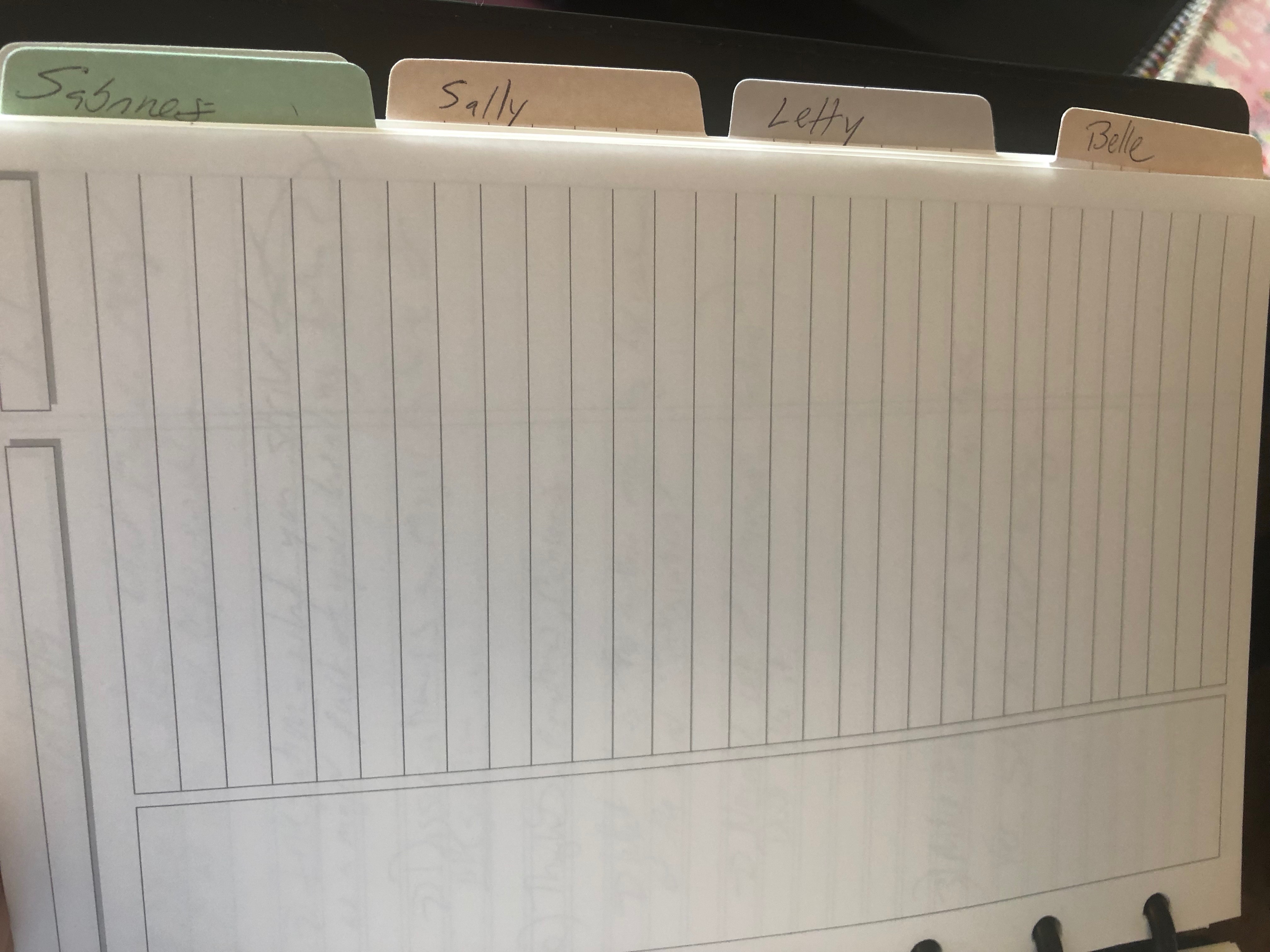
I bought a notebook for my homework in the group. I found that parts also liked just writing in the notebook. However, I quickly learned there was conflict among parts as to where each part could write. Now everyone has their own tab and area within the notebook to write. All parts seem to be content with this solution. It surprises me that I still find content I don’t recall writing, but now with the tabs I know who’s writing! I always appreciate clues. Should have implemented this solution years ago.

IMG_0970