There’s a dog in my life

There’s a dog in my life who came by way of his own trauma. Thurman is a Maltese who spent the first 7 years of his life in a cage breeding. His hair fell out from neglect, and when the owners took him to the vet the vet took Thurman from them and placed him in rescue. When I heard that story I remember thinking I wish I had a vet who would have told my parents you’re unfit I’m taking this child from you because that’s essentially what happened to Thurman. 

Thurman languished in foster care because his hair took some time to grow back, and he was extremely aloof. He’s not the kind of dog that cuddles or licks people. We took one look at him, and we told his foster mom, “Oh we understand his situation, we’re happy to have him.” And true to form, he ignored us for months. He would just eat, potty, and sleep and give us sideways suspicious glances. It was cool to see him discover blankets and sheets and comfort. Though he didn’t like us seeing him bask in comfort. If Thurman saw us glancing at him while he rubbbed his face in the blanket he would stop and I swear he would look a little embarrassed. 

If you pet him too long, or heaven forbid, if Letty hugs him too long, he takes off. And forget having him cuddle with you or even nestle into you. That was just not something in the cards for him, until it was. We got him December 2019, right before COVID. For all those years he never came to me or snuggled with me until that Saturday last month when the first memories fell out of my brain. 

That Saturday night I was on the couch crying when Thurman got up from his corner of the couch, climbed on top of me, and then just settled into me like it was something he did every night. I was so in my own hellspace that I hardly noticed it. In fact, my wife brought my attention to it by her own reaction, “The dog, baby! He knows you need comfort. Look at that!” In my own fuzzy universe I finally truly felt Thurman on me. And you would think my reaction would be something like, “Oh Thurman, I love you, too.” Instead, I remember thinking to myself, “Really, Thurman, now I’m going to remember this moment together with one of the worst moments of my life.” 

And sure enough this morning I found him cuddled up next to me on the bed, and I had a moment of joy followed by sadness that just sticks and doesn’t let go, and I think it’s going to be that way for a long time.

Maybe sometimes it’s better not to know

I now know what I didn’t know last Saturday before noon. I know so much more, and yet I know I probably know only a small window, but that small window is plenty to hurt the heart. I came to this dissociation journey with parts first, and just hazy memories that really didn’t compute for me how they led to the parts I have. When the question would come up if I am a survivor, I would say, “I guess?” in that not so sure, questiony, wishy washy answer that would annoy me because it’s not like me to be wishy washy with answers.

And the memories keep coming like a flood, a freight train. So much crying and so much pretending. Pretending because I have to work. Thank god for remote work. Thank god for parts. I’ll cry, and then my part that loves to work will emerge like magic for a meeting. Then, when it’s done, we’ll cry for a spell. I’m thankful that I’m not called upon all too often for a sudden or unplanned need for an on-camera meeting. Usually, if something comes up, I just get a Teams message. I can read a Team message through tears. Sure, I welcome work distractions while my brain is flooded with images. For a spot of time, I can pretend I don’t have images in my head, and I can work on something someone needs from me.

On a good day, my work part will completely take over, and I’ll feel like I can do anything because this part is, quite frankly, awesomely confident and unflappable. I have a new therapist, and he called me this week on one of those good days. He caught on right away that a different part was talking to him on the phone. He said, “Hmmm, who am I speaking with?” The next day he said to me, “She’s so articulate!” I said, “Yes, I wish she was here all the time.”

I’ll get a respite from the memories, and I’ll mistakenly think it’s over. And I’ll feel almost like myself again. But, it’s a trick. They come back. I asked my wife, “Do you think it’s over? That’s it?” She just looked at me with so much love, and I don’t remember what she said, but I know it was an answer I didn’t want to hear. And, yes, later that same day the memories were back, like they never left.

I thought, wrongly, that I knew all there was to know about that place and time. After all, I knew what I knew, and nothing more.

Learning to Listen

I started attending a group for people with dissociative identity disorder back in June of this year. It was quite a process just to get into it. There was an intake, an extensive intake, of which I was quite resistant with many of the questions. I was asked the ages of my parents and whether they were deceased, to which I answered, “No idea.” When asked to describe my relationship with each parent I said, “Terrible, and don’t care to elaborate today.” There were 16 possible boxes to check under the Family Psychiatric History section. I checked 12 out of the 16 boxes. I was asked to elaborate on all the boxes I checked, and I replied, “Don’t care to do so today.”

The intake form, 3/4 of the way through asked me to talk about my strengths, and I answered by stating, “Not robotically answering questions on an intake form.”

It’s a small wonder I was allowed into this group. I think it may have helped that one of the facilitators was not meeting me for the first time.

We will meet for something like 36 weeks, and we are 8-10 sessions in (I’ve not kept track of the exact number). It’s become one of those things that I look forward to every week, and, at the same time, I don’t want to turn my check in because it’s a lot of money that is not covered by insurance. I know it’s rare to have such a group for DID folks, and I am grateful and always do math in my head each week when I turn in my payment.

It’s hard to run away from this condition when you’re talking about the challenges with having parts every week. Sometimes I feel myself start to slip away during the group, but I can see I’m not alone with the struggle. I’ve known before I started the group that it’s important to listen to my parts, and have consistent communication and collaboration. I’ve learned that one can know that, yet not do it any consistent manner. I’ve found myself in the place where it’s easy to listen to the part or parts that are usually near the front. Those voices at the back get drowned out, and they start to come out sideways because when a part is not heard that is when I start to feel off. But, I don’t usually think to inquire or listen to see if a part needs something when I start to struggle.

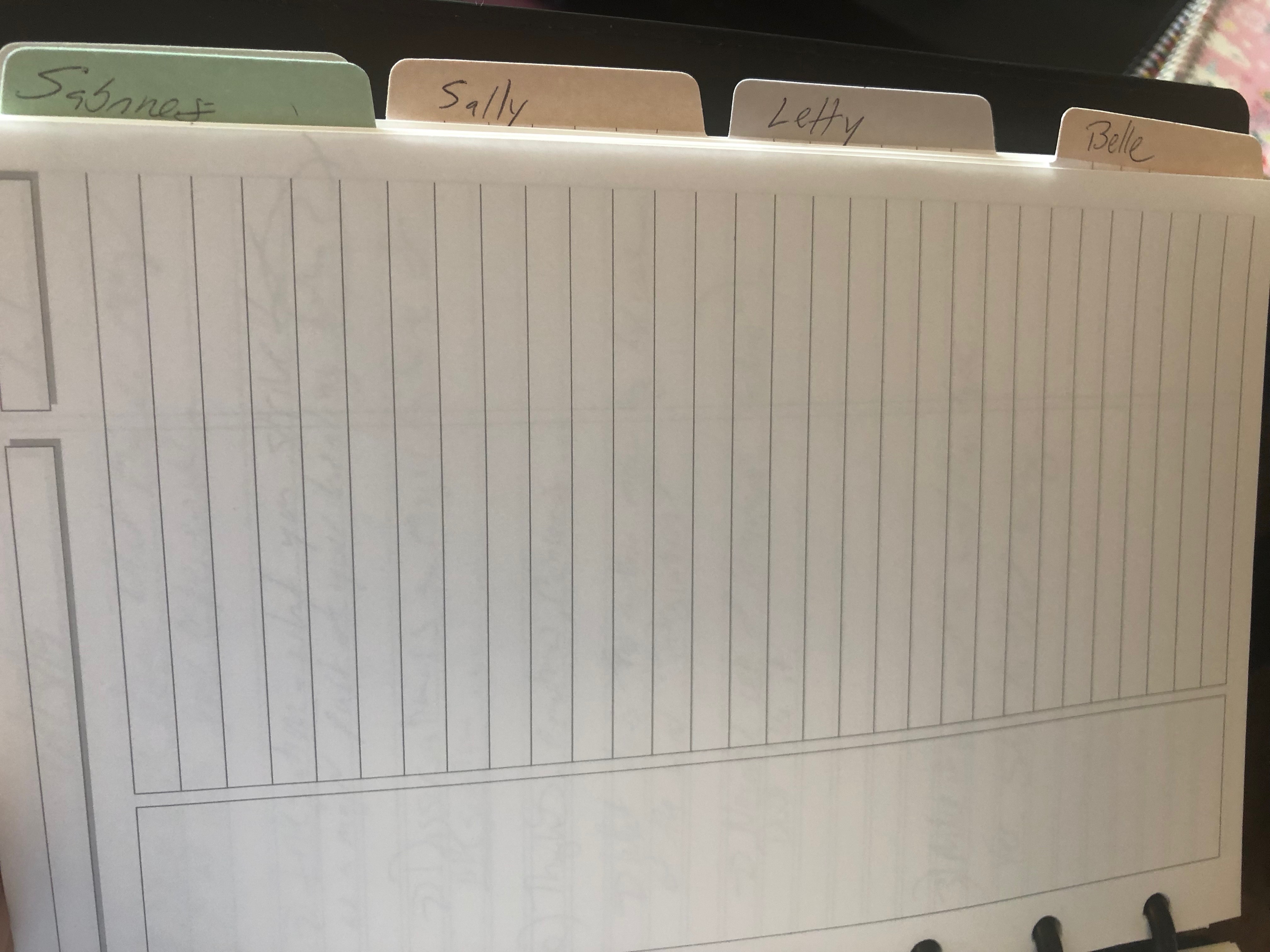
I bought a notebook for my homework in the group. I found that parts also liked just writing in the notebook. However, I quickly learned there was conflict among parts as to where each part could write. Now everyone has their own tab and area within the notebook to write. All parts seem to be content with this solution. It surprises me that I still find content I don’t recall writing, but now with the tabs I know who’s writing! I always appreciate clues. Should have implemented this solution years ago.

IMG_0970